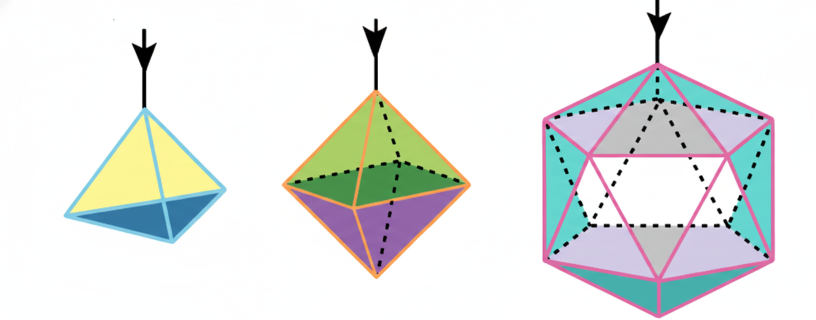
Polyhedrons (or polyhedra) are 3D solid shapes made only of flat polygon faces. They have straight edges and corner points called vertices. A cube has six square faces, a dodecahedron has 12 pentagonal faces, and an icosahedron has 20 triangular faces.
Equipotential Planes The secret lies in visualization. Instead of seeing a mess of wires, If we imagine "hanging" the shape from the input vertex, the vertices naturally arrange themselves into horizontal layers, or equipotential planes.
• The Insight: Vertices in the same horizontal layer are at the exact same electrical potential.
• The Result: No current flows between vertices in the same layer. This allows us to treat the connections between layers as simple groups of resistors in parallel, turning a 3D grid problem into a simple 1D line of resistors.
The "Superposition" Trick The method gets truly clever when you need to calculate resistance between any two points, not just opposite corners. We use the principle of superposition to combine two theoretical scenarios:
1. Inject current: A current $I$ injected into a single vertex (Vertex A) which then exits uniformly from other vertices $\frac{I}{H-1}$ from each each vertex.
2. Extract current: A current I is extracted from a vertex (Vertex B) which enters uniformly from other vertices.
When these two situations are superposed a current of magnitude $I\frac{I}{H-1}$ enters at A and exits at B. The equivalent resistance is defined as
$$\boxed{ Re(i) = \frac{2R}{H} \sum_{j=1}^{i} \frac{1}{n_j} \left( H - \sum_{k=0}^{j-1} q_k \right) }$$
while this expression might look terrifying, once the approach is clear to you, question will be a piece of cake for you. I have uploaded two videos on my channel physics educator on YouTube. I am sharing their link here.
 Launch your Graphy